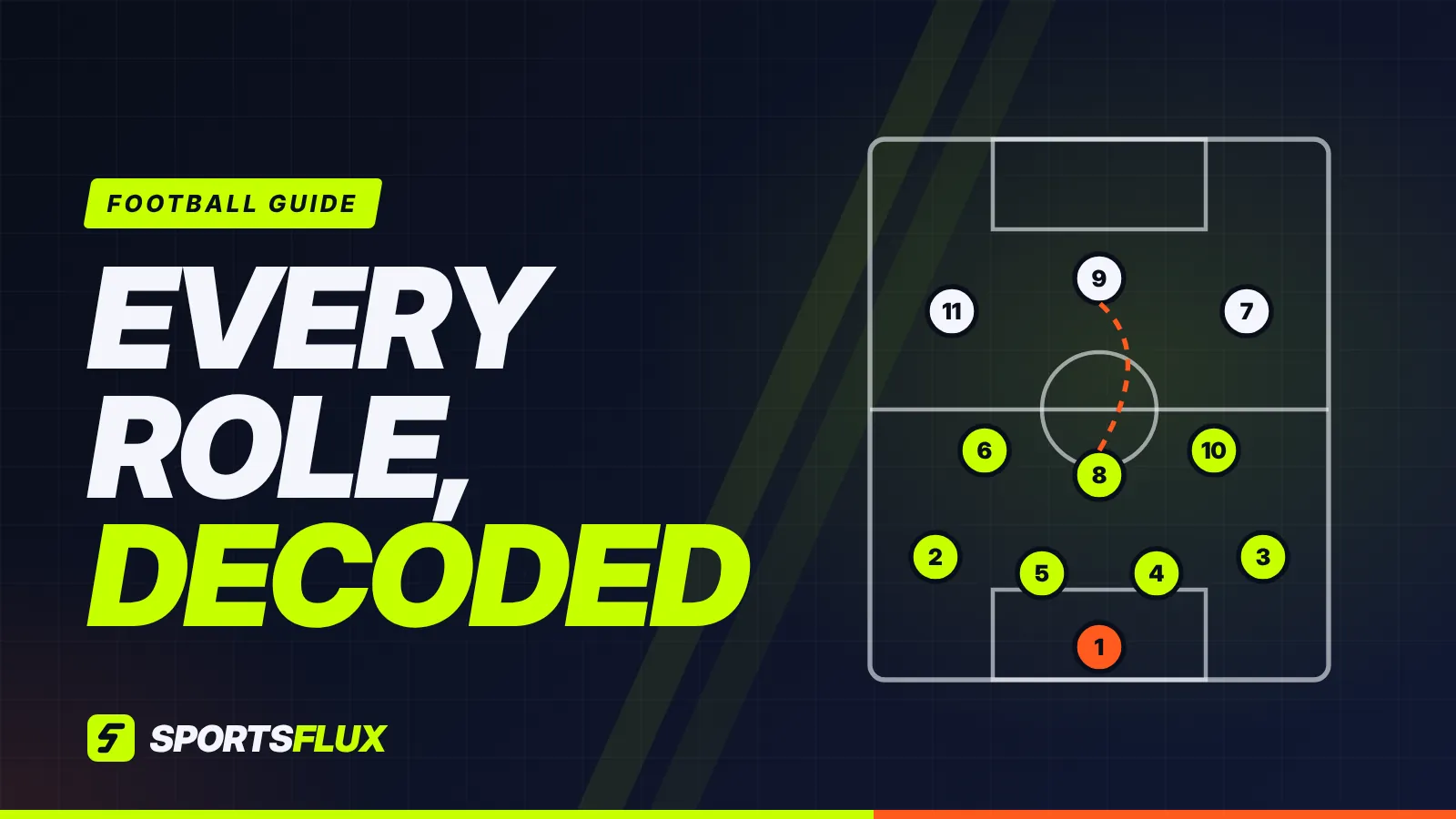
There are 11 football positions on the pitch at any time: one goalkeeper plus ten outfield players split across defence, midfield and attack. The core roles are goalkeeper, centre-back, full-back, defensive midfielder, central midfielder, attacking midfielder, winger and striker. How a team arranges them is called its formation.
This guide breaks down every position in football (soccer), what each player actually does, the classic shirt numbers, and how the most common formations fit together. If you coach, play or just want to watch smarter, start here.
In this guide
Formation Basics: How Football Positions Fit Together
Under Law 3 of the IFAB Laws of the Game, each team fields a maximum of eleven players, one of whom must be the goalkeeper. A match cannot start or continue if a side drops below seven players. Everything else about positions is tactical, not legal.
Formations are written as numbers from back to front, ignoring the goalkeeper. A 4-3-3 means four defenders, three midfielders and three forwards. The numbers always add up to ten.
Keep two ideas in mind as you read on:
- Positions are starting points. Modern players rotate, overlap and swap zones constantly, so the shape on the team sheet rarely matches the shape during play.
- Shape changes with the ball. Many teams defend in one structure (say, 4-4-2) and attack in another (say, 3-2-5).
If you are still getting to grips with offside, fouls and restarts, read our guide to football rules explained first, because many positional duties exist to exploit or protect against those laws.
Goalkeeper
The goalkeeper is the most specialised of all football positions and the only player allowed to handle the ball, and only inside their own penalty area. Their first job is shot-stopping, but the modern keeper does far more.
- Shot-stopping and positioning: narrowing angles, reacting to deflections and saving one-on-ones.
- Commanding the box: claiming crosses and organising the defence at set pieces.
- Distribution: playing short passes out from the back or launching quick counter-attacks with long throws and kicks.
- Sweeping: rushing off the line to clear balls played in behind a high defensive line.
Key skills include reflexes, bravery, concentration and, increasingly, confident footwork under pressure.
Defenders
Defensive football positions form the base of every team. Get them wrong and no amount of attacking talent will save you.
Centre-backs
Centre-backs (also called central defenders) guard the middle of the pitch in front of goal. Most teams play two; three-at-the-back systems use three. They mark strikers, win headers, block shots and hold the defensive line together.
The best centre-backs read danger early rather than relying on last-ditch tackles. In possession, they are often the first link in the build-up, so passing range and composure matter as much as strength in the air.
Full-backs
Full-backs play on the right and left of a back four. Defensively, they stop opposing wingers and cover the space outside the centre-backs. Going forward, they overlap or underlap the winger to create two-against-one situations and deliver crosses.
Some coaches now use “inverted” full-backs, who step into midfield when their team has the ball. That role demands the passing and awareness of a central midfielder.
Wing-backs
Wing-backs appear in back-three systems such as 3-5-2 or 3-4-3. With three centre-backs behind them, they push higher than full-backs and are often the team’s main source of width. Expect them to cover the whole flank, from their own box to the opponent’s byline.
Stamina is non-negotiable. A wing-back who cannot get back in time leaves the defence badly exposed on the counter-attack.
Midfielders
Midfield is where games are controlled. The three main midfield football positions differ mostly in how close to their own goal they operate.
Defensive midfielder (the “holding” role)
The defensive midfielder sits just in front of the back line, screening passes into the strikers and breaking up attacks. In possession, they collect the ball from defenders and recycle it, keeping the team balanced.
Key traits are positional discipline, tackling, interceptions and simple, reliable passing. Some teams use a deep-lying playmaker here instead, a player who dictates tempo with longer passes.
Central midfielder
The central midfielder, often called the box-to-box midfielder, links defence and attack. They press, cover ground, support attacks and arrive late in the box for shots.
This role rewards all-round ability: endurance, passing under pressure, tackling and good decision-making about when to join an attack and when to hold position.
Attacking midfielder
The attacking midfielder, or “number 10”, operates in the pockets between the opposition’s midfield and defence. Their job is to create chances through final passes, dribbles and clever movement, and to score from outside the box.
Vision, close control, quick turns and calmness in tight spaces are essential. Because they can be a defensive weak point, many modern 10s are also expected to lead the press.
Forwards
Attacking football positions carry the most glamour and the most pressure, because they are judged on goals and assists.
Wingers
Wingers play wide in attack. A traditional winger hugs the touchline, beats the full-back on the outside and crosses. An inverted winger plays on the side opposite their stronger foot, so they can cut inside to shoot or slide a pass through.
Pace, dribbling, acceleration and end product (goals and assists) define a good winger. Defensively, they are often asked to track the opposing full-back.
Strikers
The striker, or centre-forward, is the main goal threat. Classic types include the target man, who holds up the ball and wins headers, and the poacher, who lives on the shoulder of the last defender and finishes chances in the box.
Movement is everything: timing runs to stay onside, pulling defenders out of position and arriving at the right spot for a cross. Clinical finishing with both feet and the head is the core skill.
False nine
A false nine starts as the central striker but drops deep into midfield. If the centre-backs follow, space opens behind them for wingers or midfielders to run into. If they stay, the false nine gets time on the ball to create.
The role suits technically gifted forwards with excellent vision, rather than pure finishers.
Football Positions Table: Numbers, Duties and Key Skills
Shirt numbers originally reflected positions, and the classic numbering below is still widely recognised. Conventions vary by country, though, and in most professional leagues players choose fixed squad numbers that need not match their role.
| Position | Traditional number | Main duties | Key skills |
|---|---|---|---|
| Goalkeeper (GK) | 1 | Stop shots, claim crosses, start attacks | Reflexes, handling, communication, footwork |
| Right-back (RB) | 2 | Defend the flank, overlap in attack | Pace, tackling, crossing, stamina |
| Left-back (LB) | 3 | Defend the flank, overlap in attack | Pace, tackling, crossing, stamina |
| Centre-back (CB) | 4, 5 | Mark strikers, win headers, organise the line | Heading, positioning, strength, passing |
| Defensive midfielder (DM) | 6 | Screen the defence, win the ball, recycle possession | Discipline, interceptions, simple passing |
| Central midfielder (CM) | 8 | Link defence and attack, cover ground | Endurance, passing range, tackling |
| Attacking midfielder (AM) | 10 | Create chances between the lines | Vision, close control, final pass, shooting |
| Right winger (RW) | 7 | Beat full-backs, cross, cut inside | Pace, dribbling, crossing, finishing |
| Left winger (LW) | 11 | Beat full-backs, cross, cut inside | Pace, dribbling, crossing, finishing |
| Striker (ST/CF) | 9 | Score goals, hold up play, press defenders | Finishing, movement, heading, strength |
| Wing-back (RWB/LWB) | Varies | Provide width in a back three | Stamina, crossing, recovery pace |
Common Formations Explained
The same football positions can be arranged in very different ways. These four shapes are the ones you will see most often, from grassroots to elite level.
| Formation | Shape (back to front) | Strengths | Weaknesses |
|---|---|---|---|
| 4-3-3 | 4 defenders, 1 holding + 2 central midfielders, 2 wingers + 1 striker | Natural width, strong pressing, triangles all over the pitch | Full-backs can be isolated; midfield can be outnumbered by a five |
| 4-2-3-1 | 4 defenders, 2 deeper midfielders, 3 attacking midfielders, 1 striker | Very balanced; double pivot protects the defence | Lone striker can become isolated without runners |
| 3-5-2 | 3 centre-backs, 2 wing-backs + 3 central midfielders, 2 strikers | Midfield overload, two strikers, extra centre-back cover | Wing-backs must work relentlessly; space behind them |
| 4-4-2 | 4 defenders, 4 midfielders in a line, 2 strikers | Simple, compact defending; clear partnerships | Two central midfielders can be outnumbered in possession |
4-3-3
The 4-3-3 relies on wingers to stretch the pitch and a single holding midfielder to keep balance. It suits possession-based and high-pressing teams, as the front three can squeeze the opponent’s back line.
4-2-3-1
Two defensive-minded midfielders (the “double pivot”) give security, freeing a number 10 and two wide players to attack. It is popular because it adapts easily into a 4-4-1-1 when defending.
3-5-2
Three centre-backs allow the wing-backs to push on, while three central midfielders control the middle. Two strikers can work as a pair, one dropping and one running in behind.
4-4-2
The classic 4-4-2 builds two compact banks of four. It is easy to teach and hard to play through, which is why many teams still use it as a defensive block even if they attack in another shape.
How to Pick a Position as a Youth Player
When it comes to football positions, the best choice for young players is often “all of them” for a while. Many coaching bodies encourage children to try different roles before specialising, because it builds a fuller understanding of the game.
- Play everywhere first. Rotating through defence, midfield and attack (and a spell in goal) develops both feet, scanning and decision-making.
- Notice what you enjoy. Do you love tackling, creating, scoring or organising? Enjoyment keeps young players training.
- Match your strengths honestly. Quick and direct? Try the wing or full-back. Calm on the ball and good at seeing passes? Central midfield. Brave and vocal? Centre-back or goalkeeper.
- Ask your coach. Coaches see patterns you might miss, such as a natural instinct for space or reading danger.
- Train the athletic base. Every role needs acceleration and quick changes of direction. Our speed and agility drills are a good place to start.
- Stay flexible. Bodies and skills change through the teenage years, and versatile players get more minutes.
Remember that the positions in football you play at 11 rarely define you at 18. Plenty of top defenders started as forwards, and vice versa.
Frequently Asked Questions
How many football positions are there?
There are 11 players per side, but the number of named football positions depends on how detailed you get. The broad groups are goalkeeper, defenders, midfielders and forwards. Within those, common roles include centre-back, full-back, wing-back, defensive, central and attacking midfielder, winger, striker and false nine.
What is the hardest position in football?
There is no official answer, but goalkeeper is often called the toughest because mistakes usually lead directly to goals. Central midfield is also demanding, as it requires stamina, passing, tackling and constant decision-making. The hardest position for you depends on your physical and technical strengths.
What does a number 10 do in football?
A number 10 is the attacking midfielder who plays between the opponent’s midfield and defence. Their job is to create chances with killer passes, dribbles and clever movement, and to chip in with goals. The number 10 is traditionally a team’s creative hub and main playmaker.
What is the difference between a full-back and a wing-back?
A full-back plays on the flank of a back four and balances defending with overlapping runs. A wing-back plays in a system with three centre-backs, so they can push much higher and act almost as a winger. Wing-backs usually cover more ground and provide most of their team’s width.
Do shirt numbers have to match positions?
No. The Laws of the Game do not tie shirt numbers to football positions. Traditional numbering, such as 1 for the goalkeeper and 9 for the striker, is a convention. In most professional leagues players have fixed squad numbers for the season and can choose numbers unrelated to their role.
Key Takeaways
- Each team has 11 players: one goalkeeper and ten outfield players across defence, midfield and attack.
- Formations are read back to front and always total ten outfield players.
- Modern football positions are fluid, with full-backs, wingers and strikers often swapping zones.
- Youth players benefit from trying several roles before settling on one.
Now that you know who does what, the next step is spotting it live. Check our major sporting events calendar for 2027 and watch how different teams line up.